Muslim wedding invitations
A Muslim wedding invitation has to carry more than a date and a hall. It opens with the Bismillah, it names both families and often the grandparents, it usually sets the Hijri date beside the English one, and it covers several occasions rather than one — the Nikah, the Walima, and the Mehendi before them. Every Elzoka design in this collection is built for that, and is shared as a single link on WhatsApp.
The Muslim design

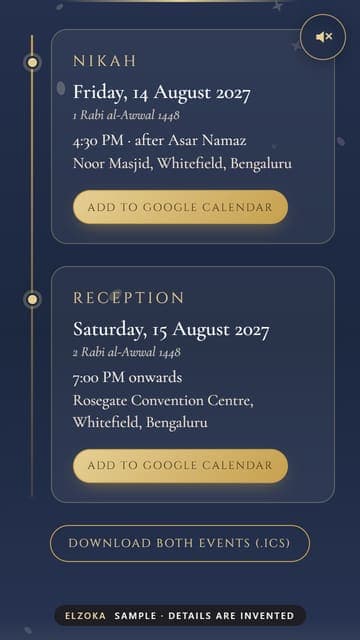
What a Muslim invitation has to carry.
- The Bismillah
- In the name of Allah, the Most Gracious and the Most Merciful — set at the head of the invitation, before any name or date.
- Nikah
- The ceremony itself, with its own date, its own time and its own venue. This is the event the countdown runs to.
- Walima
- The reception, usually hosted by the groom's family and often on a different day. It gets its own section, not a footnote.
- Mehendi
- Held before the wedding, and frequently at a third venue. Designs here carry three events without the layout breaking.
- The Hijri date
- Set alongside the Gregorian one — 11 Rabi Al-Awwal 1449 beside 13 August 2027 — because both are how families read a wedding date.
- Both families, in full
- Parents named, grandparents where the family wants them, and Marhoom before the name of anyone who has passed away.
Your wording is set exactly as you send it. We never change how a name is spelled, shorten a family line to fit, or substitute different words — if something does not fit, the design is adjusted around your text rather than your text around the design.
Muslim invitation questions.
Can the invitation show the Hijri date as well as the English date?
Yes, and both are set on the invitation together. Each event carries its Gregorian date and its Hijri date — for example 11 Rabi Al-Awwal 1449 beside Friday 13 August 2027 — because families read the wedding date in both, and leaving one out means somebody has to convert it themselves.
Can one invitation cover the Nikah, the Walima and the Mehendi?
Yes. Each occasion gets its own section with its own date, time and venue, and each venue gets its own map link. Three events at three different halls is the normal case for these designs, not an exception you have to squeeze in at the end.
Will the invitation include our parents' and grandparents' names?
Yes, written the way your family writes them. Both sides are named, grandparents are included when you want them, and Marhoom is set before the name of a relative who has passed away. You tell us the wording and we set it exactly as given — we never change how a name is written.
Do these designs use photographs of the couple?
Only if you want them to. Some families prefer an invitation set in typography and ornament with no photographs at all, and at least one design in this collection is built that way deliberately. Each design's page says whether it uses your own photographs.