Hindu wedding invitations
A Hindu wedding invitation is rarely one event on one day. It opens with an invocation to Ganesha, it sets the muhurtham to the minute because the hour was chosen rather than picked, and it carries the Haldi, the Mehendi, the Sangeet and the wedding itself — often at three or four different addresses across two or three days. Every Elzoka design in this collection is built to hold all of that without the layout giving way, and is shared as a single link on WhatsApp.
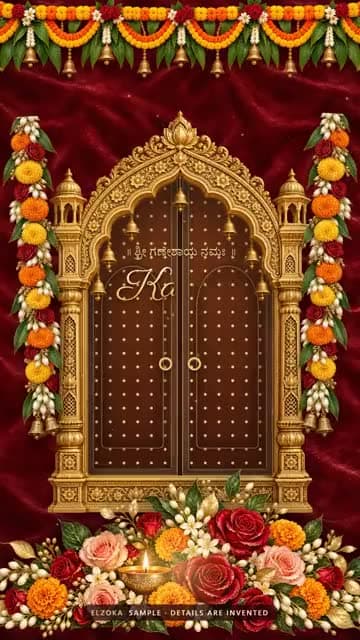
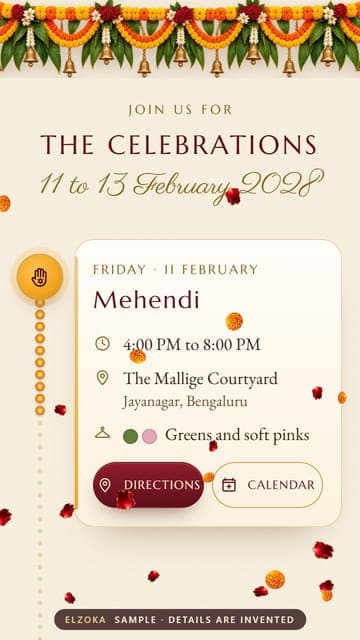
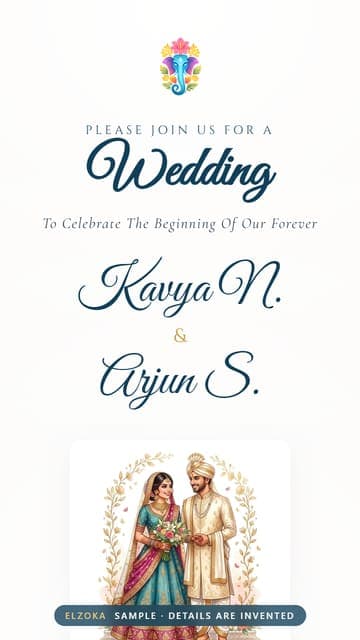

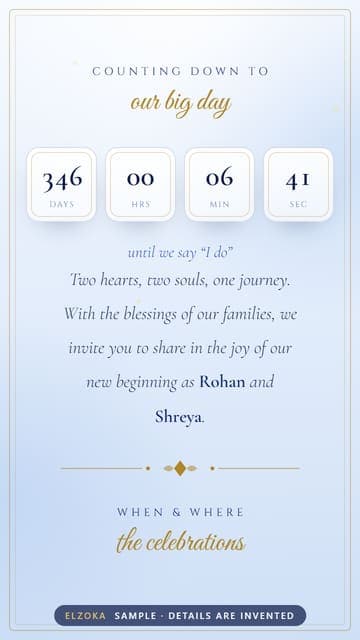
What a Hindu invitation has to carry.
- The Ganesha invocation
- Shree Ganeshaya Namah, or the form your family uses, set at the head of the invitation before any name or date — because nothing auspicious begins without it.
- The muhurtham, to the minute
- 11:01 AM, not “around 11”. The auspicious time is calculated, so the invitation prints it exactly as the family was given it. This is the single detail people most often find rounded off elsewhere, and rounding it changes what the invitation says.
- Haldi and Mehendi
- Usually the morning and afternoon before the wedding, and frequently at the family home rather than the hall — so each gets its own address and its own map link, not a shared one.
- Sangeet
- Its own evening, its own venue, and often the largest gathering of the three. It is a separate event on the invitation, not a line under the wedding.
- The wedding itself
- Named the way your family names it — Vivah, Kalyanam, Shubh Vivah or Lagna — and the ceremonies within it too, whether that is the Kanyadaan and Saptapadi, the phere, or the Mangalya Dharanam.
- Both families, in full
- Parents named on both sides, grandparents where the family wants them, and the late named as the family writes them. You give us the wording and we set it exactly as given.
- The reception
- Frequently a different day and a different hall from the wedding, sometimes hosted by the other side of the family. It gets its own section rather than a footnote.
Your wording is set exactly as you send it. We never change how a name is spelled, shorten a family line to fit, or substitute different words — if something does not fit, the design is adjusted around your text rather than your text around the design.
Hindu invitation questions.
Can one invitation hold the Haldi, Mehendi, Sangeet and the wedding?
Yes, and that is the normal case for these designs rather than something to squeeze in. Each occasion gets its own card with its own date, time and venue, and each venue gets its own map link — because guests coming for the Sangeet often are not coming to the Haldi, and they need the right address, not the main one.
Will the muhurtham time be printed exactly as our astrologer gave it?
Yes, to the minute. If the time is 11:01 AM the invitation says 11:01 AM. We never round an auspicious time to something tidier, and we never move it to fit a layout — if it does not fit, the design changes, not the time.
Can the invitation open with the Ganesha invocation?
Yes. It is set at the head of the invitation, above the names and the date, in the form your family uses — Shree Ganeshaya Namah, Vakratunda Mahakaya, or another. You tell us the wording and we set it as given rather than substituting a version we prefer.
Do you have designs for South Indian and North Indian weddings?
Both. Some designs in this collection are built around a South Indian mandapam and name the Nischayathartham, the Kalyanam and the Saptapadi; others are built around a North Indian palace setting and name the Ganesh Pujan, the phere and the baraat. The ceremony names on every design are yours to set, so a design from either side can carry your wording.
Do these designs use photographs of the couple?
Only where the design has a place for one. Several designs in this collection are set entirely in typography, ornament and illustration with no photograph anywhere, which many families prefer. Each design's page says whether it uses your own photographs, and you are never asked to send pictures a design cannot show.